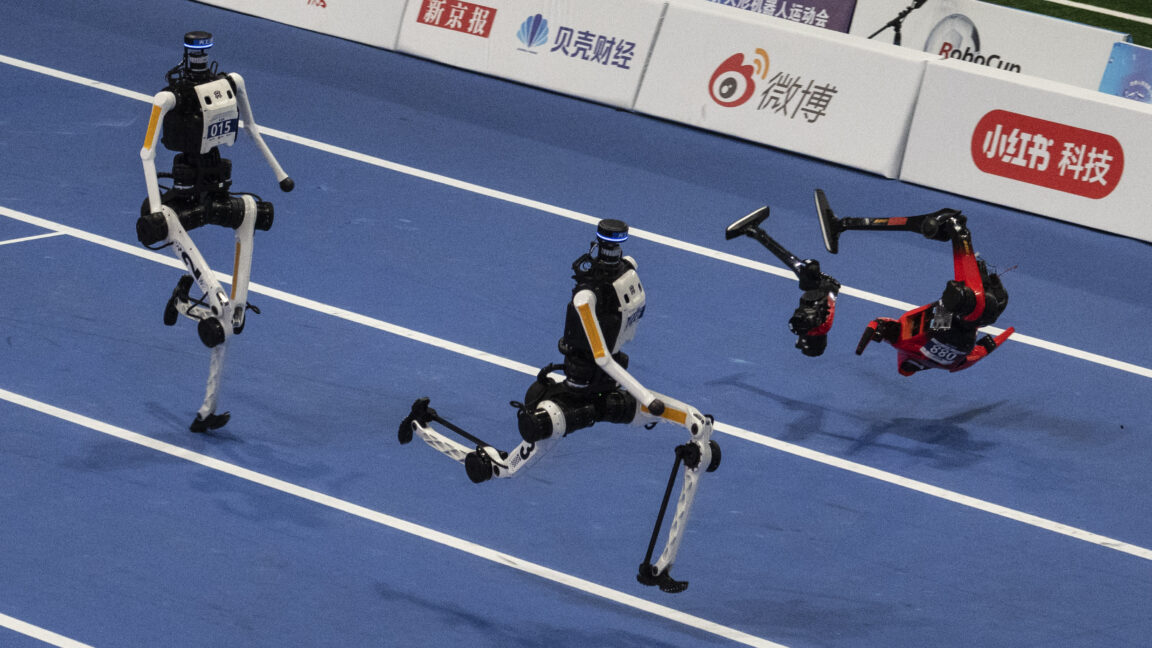
World Humanoid Robot Games Showcase Record-Breaking Performances

Edited by Lyra Voxley
Models & Research · Updated August 26, 2026
The recent World Humanoid Robot Games featured record-breaking performances from humanoid robots, particularly in racing events. However, these races were deemed less significant compared to challenges focused on household chores, highlighting a shift in priorities within the robotics community.
Sources reviewed
1
Linked below for direct verification.
Official sources
0
Preferred when available.
Review status
Human reviewed
AI-assisted draft, editor-approved publish.
Confidence
High confidence
85/100 from the draft pipeline.
This AI Signal brief is meant to save busy builders time: what changed, why it matters, and where the reporting comes from.
This story appears to rely mostly on secondary or mixed-source reporting, so readers should treat it as a developing summary rather than a final word. If you spot an issue, email [email protected] or read our editorial standards.
Share this story
Why it matters
- ✓Developers can gain insights into the evolving focus of humanoid robotics, emphasizing practical applications over entertainment.
- ✓Product teams may need to pivot their strategies to prioritize functionality in household tasks, which could lead to increased demand for robots that assist with daily chores.
- ✓Operators of humanoid robots can learn from the performance metrics of these events to enhance their designs and improve reliability in real-world applications.
World Humanoid Robot Games Showcase Record-Breaking Performances
The World Humanoid Robot Games recently captured attention with robots achieving record-breaking speeds in racing events. However, the significance of these races has been called into question, as they are considered less impactful than challenges that focus on performing household chores. This shift in focus within the robotics community underscores a growing interest in practical applications for humanoid robots.
What happened
During the World Humanoid Robot Games, various humanoid robots participated in races that set new speed records. Despite the excitement surrounding these achievements, experts noted that the racing events might not hold as much relevance for the future of robotics as challenges that involve completing everyday tasks. The emphasis on household chore challenges reflects a broader trend in robotics, where functionality and utility are becoming more critical than mere performance metrics.
Why it matters
The outcomes of the World Humanoid Robot Games have several implications for developers, builders, operators, and product teams:
- Insights for Developers: The shift towards household chore challenges indicates a need for developers to focus on creating robots that can assist with daily tasks rather than just racing for speed. This could lead to innovations in robot design and functionality.
- Strategic Shifts for Product Teams: As the industry pivots towards practical applications, product teams may need to reassess their strategies. There could be an increased demand for robots that can perform household chores, which may influence product development cycles and marketing strategies.
- Performance Metrics for Operators: Operators can analyze the performance data from the racing events to enhance their humanoid robots' designs. Understanding what works in competitive settings can inform improvements in reliability and functionality in real-world applications.
Context and caveats
While the World Humanoid Robot Games showcased impressive technological advancements, it is essential to recognize that the sourcing for this information is limited. The focus on racing events may overshadow other critical developments in robotics, particularly those that address practical needs in everyday life. As the industry evolves, it will be crucial to monitor how these trends affect future innovations and applications in humanoid robotics.
What to watch next
Looking ahead, it will be interesting to see how the robotics community responds to the insights gained from the World Humanoid Robot Games. Key areas to watch include:
- The development of humanoid robots designed specifically for household tasks and their integration into daily life.
- Emerging competitions or events that emphasize practical applications over speed and performance.
- The potential for collaboration between developers and product teams to create robots that meet the needs of consumers in a rapidly changing technological landscape.
In conclusion, the World Humanoid Robot Games have highlighted a pivotal moment in the robotics industry, where the focus is shifting from performance metrics to practical applications. This trend presents new opportunities and challenges for developers, builders, operators, and product teams as they navigate the evolving landscape of humanoid robotics.
Sources
Newsletter
Weekly AI signal. No spam.
More in Research

AI Models Struggle to Decode Complex Human Genomes
Current AI models are not yet equipped to effectively decode the complexities of human genomes due…
1h ago

Concerns Raised Over Chatbots Using Personal Pronouns
MIT professor Sherry Turkle has expressed concerns about the increasing emotional entanglement…
19h ago

OpenAI Launches GPT-Rosalind Academic Plan for Research Labs
OpenAI has introduced the GPT-Rosalind Academic Plan, which provides eligible academic research…
1d ago

Hugging Face Introduces 2.8 Trillion Tokens for Indic Language Pretraining
Hugging Face has announced a significant advancement in pretraining models for Indic languages,…
1d ago
Comments
Sign in to join the discussion
Loading comments…