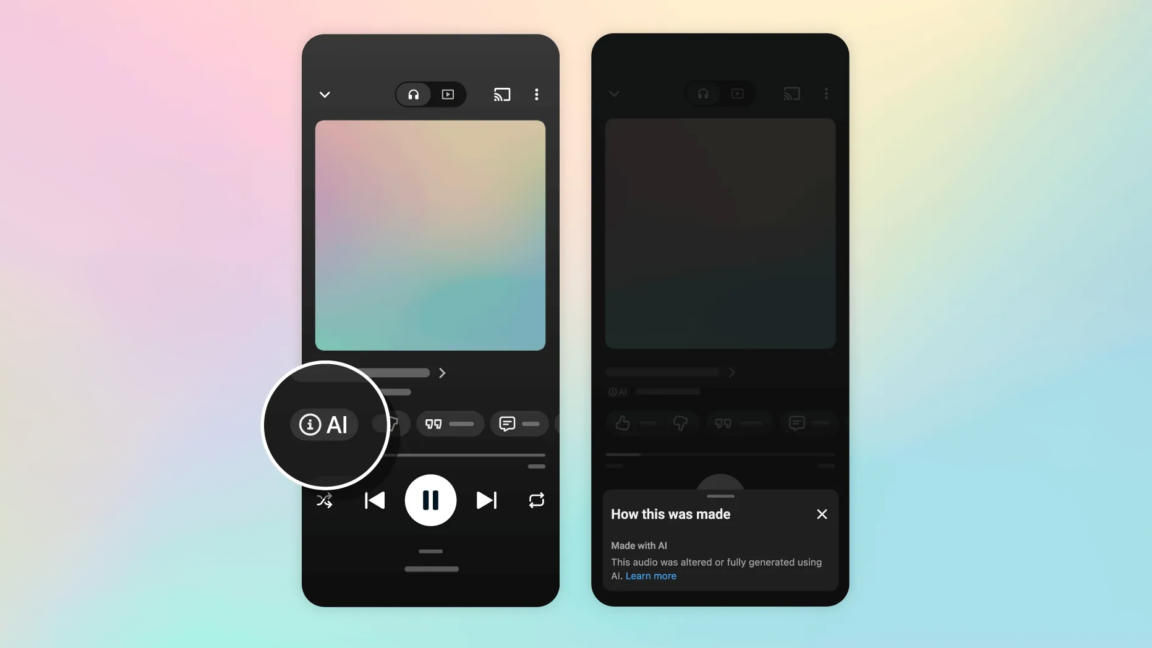
YouTube Music Introduces AI Labeling for Songs

Edited by Orin Codewell
Tools & Coding · Updated October 19, 2026
YouTube Music has begun rolling out new AI-generated labels that categorize songs as either 'singer' or 'clanker.' This feature is expected to enhance user experience by providing clearer distinctions between types of music. The labeling system will also be implemented on YouTube in the near future.
Sources reviewed
1
Linked below for direct verification.
Official sources
0
Preferred when available.
Review status
Human reviewed
AI-assisted draft, editor-approved publish.
Confidence
High confidence
90/100 from the draft pipeline.
This AI Signal brief is meant to save busy builders time: what changed, why it matters, and where the reporting comes from.
This story appears to rely mostly on secondary or mixed-source reporting, so readers should treat it as a developing summary rather than a final word. If you spot an issue, email [email protected] or read our editorial standards.
Share this story
Why it matters
- ✓Developers can leverage the AI labeling system to create more personalized music recommendations based on user preferences.
- ✓Product teams can integrate these labels into user interfaces, improving navigation and discovery of music content.
- ✓Operators can utilize the data from AI labels to analyze trends in music consumption and user engagement.
YouTube Music Introduces AI Labeling for Songs
YouTube Music has recently announced the rollout of a new feature that employs artificial intelligence to label songs as either 'singer' or 'clanker.' This innovative approach aims to enhance the user experience by providing clearer categorizations of music, allowing users to make more informed choices about what they listen to. The AI labeling system is set to expand to YouTube soon, indicating a broader application of this technology across the platform.
What happened
According to a report from Ars Technica, YouTube Music is implementing AI-generated labels that categorize songs based on their characteristics. The labels 'singer' and 'clanker' are designed to help users quickly identify the type of music they are engaging with. This feature is currently being rolled out on YouTube Music and is expected to be available on YouTube in the near future.
The introduction of these labels represents a significant step in how music is categorized and consumed on digital platforms. By utilizing AI to analyze and label songs, YouTube Music aims to streamline the user experience, making it easier for listeners to find music that suits their tastes.
Why it matters
The implementation of AI labeling in YouTube Music has several implications for developers, builders, operators, and product teams:
- Enhanced Personalization: Developers can use the AI-generated labels to create more tailored music recommendations for users. By understanding the distinctions between 'singer' and 'clanker,' algorithms can better match users with music that aligns with their preferences.
- Improved User Interface: Product teams can integrate these labels into the YouTube Music interface, enhancing navigation and making it easier for users to discover new music. Clearer categorizations can lead to a more satisfying user experience.
- Data Analysis Opportunities: Operators can analyze the data generated from these AI labels to identify trends in music consumption. Understanding how users interact with different types of music can inform future content strategies and marketing efforts.
Context and caveats
While the rollout of AI labeling in YouTube Music is a positive development, it is important to consider the limitations of the current implementation. The accuracy of AI-generated labels depends on the underlying algorithms and the data they are trained on. If the AI misclassifies songs, it could lead to user frustration and dissatisfaction. Additionally, the long-term effectiveness of this labeling system will depend on continuous updates and improvements to the AI models.
What to watch next
As YouTube Music continues to roll out its AI labeling feature, it will be interesting to observe how users respond to the new categorizations. Key areas to monitor include:
- User Engagement: Tracking changes in user engagement metrics following the introduction of AI labels will provide insight into their effectiveness.
- Feedback Mechanisms: Observing how YouTube Music gathers and responds to user feedback on the labeling system will be crucial for its ongoing development.
- Expansion to YouTube: The anticipated rollout of AI labeling on YouTube will offer a broader context for understanding how these labels impact video content and user interactions across the platform.
In conclusion, YouTube Music's introduction of AI-generated song labels marks a significant advancement in music categorization and user experience. By leveraging artificial intelligence, the platform aims to provide users with clearer distinctions between different types of music, ultimately enhancing their listening experience.
Sources
- Singer or clanker? YouTube Music will tell you with new gen AI labeling. — Ars Technica AI
Newsletter
Weekly AI signal. No spam.
More in Tools

AI Agent at Bar-Ilan University Assists Students Who Miss Lectures
Bar-Ilan University has introduced an AI agent designed to help students catch up on missed…
Just now

Microsoft Optimizes Windows for Nvidia's RTX Spark Laptops
Microsoft and Nvidia recently launched the first wave of RTX Spark laptops in San Francisco,…
13h ago

Amazon’s Bee Launches Two New Personal AI Devices Starting at $75
Amazon-owned Bee has introduced its first new AI devices since its acquisition, featuring an…
18h ago

Bluesky Launches Attie AI Tool for Creating Social Apps and Games
Bluesky has expanded its Attie AI tool, originally designed for customizing social media feeds, to…
1d ago
Comments
Sign in to join the discussion
Loading comments…